Why Some Officers Thrive in Corporate

The first job interview after retirement can be surprisingly humbling.
Not because of a lack of experience.
Quite the opposite.
Many retired military officers and law enforcement professionals walk into an interview carrying decades of leadership, operational success, crisis management, and public service. They have commanded battalions, led police districts, managed disaster response operations, investigated complex crimes, or coordinated national security initiatives.
On paper, they appear to be ideal candidates for executive security positions.
Yet many leave the interview wondering what went wrong.
The questions weren’t about tactical operations.
No one asked how many personnel they had commanded.
No one asked about firearms qualifications, operational deployments, or field accomplishments.
Instead, the conversation sounded very different.
“How would you present security risks to our Board of Directors?”
“How do you justify a ₱20 million security investment to our CFO?”
“What is your experience with enterprise risk management?”
“How would you align your security strategy with our business objectives?”
“Have you implemented compliance programs under the Data Privacy Act?”
“Tell us about a time you influenced executives who did not report to you.”
For many retiring officers, these questions feel unfamiliar—not because they lack intelligence or leadership, but because they reflect a completely different operating environment.
This is often the moment they realize something profound:
The corporate world is not looking for someone to command people. It is looking for someone who can influence an organization.
The Skills That Built Your Career May Not Be the Skills That Build Your Next One
Military and law enforcement careers develop extraordinary professionals.
They cultivate discipline, resilience, courage, accountability, and the ability to perform under immense pressure.
These qualities remain invaluable.
In fact, they are often what make former uniformed personnel attractive candidates in the first place.
However, corporate organizations evaluate leaders through a different lens.
Operational competence is assumed.
Strategic competence is examined.
The difference is subtle but significant.
A retired police colonel may know how to secure a high-risk event.
A corporate executive wants to know whether that security strategy supports business continuity, customer experience, regulatory compliance, and organizational reputation.
A former military commander understands operational planning.
A board of directors wants to understand how that plan affects shareholder confidence, legal exposure, insurance costs, and long-term organizational resilience.
The mission has shifted.
The language has changed.
And so have the expectations.
Military Leadership vs. Corporate Leadership
Leadership is leadership but context matters.
In uniformed service, leadership is reinforced by a clearly defined chain of command. Roles are established, authority is formalized, and decision-making often follows structured operational frameworks.
In corporate organizations, leadership is far less linear.
A Security Director may need to persuade a Chief Financial Officer to approve additional security investments, collaborate with Human Resources on workplace violence policies, coordinate with the Legal Department on compliance issues, and work alongside Information Technology teams to strengthen cybersecurity governance.
None of these departments report directly to the Security Director.
Influence replaces command.
Negotiation replaces orders.
Collaboration replaces hierarchy.
This transition is one of the most underestimated challenges facing retired officers.
Many discover that success is no longer determined by how effectively they manage people under their authority.
It is determined by how effectively they build trust with people who are not.
From Command Presence to Executive Presence
There is another transition that receives far less attention.
In military and law enforcement organizations, command presence is essential.
It communicates confidence, discipline, authority, and control.
Corporate leadership requires something broader.
Executive presence.
Executive presence is not about speaking louder or issuing stronger directives.
It is about communicating with clarity.
Presenting complex issues simply.
Listening before deciding.
Understanding business priorities.
Building consensus.
Speaking the language of executives rather than the language of operations.
Consider two different ways of presenting the same issue.
The first sounds operational:
“We need additional CCTV cameras because there are several vulnerable areas.”
The second sounds strategic:
“Our recent risk assessment identified surveillance gaps in critical operational areas. Addressing these vulnerabilities will reduce unauthorized access risks, strengthen compliance with our security governance framework, and support our business continuity objectives.”
Both statements recommend the same solution.
Only one resonates in an executive boardroom.
This is the difference between operational communication and executive communication.
What Companies Really Hire For
Many professionals assume companies hire Security Directors based primarily on years of service.
Experience certainly matters.
But it is rarely the deciding factor.
Organizations are looking for professionals who understand how security supports business.
Increasingly, employers seek candidates who can demonstrate expertise in areas such as:
Enterprise Risk Management
Can you identify organizational risks before they become incidents?
Can you prioritize resources based on risk rather than routine?
Corporate Governance
Do you understand how security fits into organizational accountability, regulatory oversight, and executive decision-making?
Regulatory Compliance
Can you navigate requirements involving the Fire Code of the Philippines, PNP-SOSIA regulations, Occupational Safety and Health Standards, the Data Privacy Act of 2012, and Local Government Unit requirements?
Business Continuity
Can you help ensure that operations continue during crises?
Crisis Leadership
Can you lead organizations through uncertainty while maintaining stakeholder confidence?
Executive Reporting
Can you translate operational realities into business decisions?
These are no longer “nice-to-have” competencies.
They have become essential.
Bridging the Gap Between Operational Excellence and Executive Leadership
Many retired officers don’t lack leadership—they simply haven’t had the opportunity to develop the business and governance competencies expected in today’s corporate environment.
This is exactly why the Certified Security & Safety Management Professional (CSSMP) program was developed by PASSMI. It equips experienced professionals with practical knowledge in enterprise risk management, regulatory compliance, business continuity, corporate governance, and strategic security leadership—helping bridge the gap between operational excellence and executive responsibility.
📅 Upcoming CSSMP – Visayas League
July 20–24, 2026 (Hybrid)
-
- July 20–23: Online
- July 24: Face-to-Face in Ormoc City (Examination, Defense, Graduation, and Certificate Distribution)
If you know a colleague, friend, or fellow officer assigned in Leyte, Samar, Cebu, Negros, Bohol, Iloilo, or anywhere in the Visayas, share this opportunity with them.
Register today: https://cssmp.passminc.com/
The Resume Problem Nobody Talks About
Many retired officers unintentionally undersell themselves.
Their resumes are often filled with operational accomplishments that are impressive within government service but difficult for corporate recruiters to interpret.
Consider a typical example.
Commanded 800 personnel during regional operations.
A recruiter may ask:
“What business value does that demonstrate?”
Now consider this version.
Led multidisciplinary teams of over 800 personnel responsible for operational planning, crisis response, resource management, and stakeholder coordination across multiple jurisdictions.
The experience hasn’t changed.
The language has.
Corporate recruiters are trained to identify transferable leadership competencies.
The challenge is helping them recognize those competencies.
This requires reframing—not exaggerating—your experience.
The Learning Curve That Never Ends
One of the greatest strengths many retired officers possess is their commitment to lifelong learning.
Throughout their careers, they attended command courses, leadership schools, specialized training, and professional development programs.
Ironically, some stop learning after retirement.
They assume their experience will carry them through the rest of their career.
The corporate world rarely works that way.
Business environments evolve rapidly.
Artificial intelligence is reshaping security operations.
Cybersecurity has become inseparable from physical security.
Environmental, Social, and Governance (ESG) reporting is influencing corporate priorities.
Enterprise Risk Management continues to mature.
Regulatory expectations are increasing.
The most successful professionals are not those with the longest careers.
They are those who continue adapting.
A Different Definition of Success
In government service, success is often measured through operational effectiveness.
Mission accomplished.
Incident resolved.
Public protected.
In corporate organizations, success is broader.
Security leaders are evaluated not only on what happens—but also on what doesn’t happen.
Prevented incidents.
Reduced organizational risk.
Improved compliance.
Strengthened governance.
Protected reputation.
Maintained business continuity.
The best security leaders often receive little public recognition because their greatest achievement is preventing crises before anyone notices them.
This requires a different mindset.
Reactive leadership becomes proactive leadership.
Operational excellence becomes strategic foresight.
Why Some Officers Flourish
Spend enough time in the corporate security industry and a pattern begins to emerge.
The officers who transition successfully are rarely those with the highest rank.
They are the ones who remain curious.
They ask questions.
They seek mentorship.
They study business.
They understand finance.
They learn governance.
They invest in professional certifications.
They embrace technology.
They recognize that retirement is not the culmination of their education—it is the beginning of a new phase of learning.
Their confidence comes not from what they achieved yesterday, but from their willingness to prepare for tomorrow.
The Bridge Between Experience and Executive Leadership
There is no substitute for the wisdom gained through years of public service.
Experience matters.
Character matters.
Leadership matters.
But in today’s corporate environment, organizations increasingly expect security leaders to combine operational credibility with strategic capability.
That bridge is built through continuous education, professional networking, governance knowledge, and exposure to modern business practices.
The question is no longer whether former military and law enforcement professionals have leadership potential.
They unquestionably do.
The real question is whether they are prepared to translate that potential into the language of modern organizations.
Because experience may earn you the interview.
Leadership, adaptability, and continuous learning are what earn you the opportunity to lead again.
Coming Up in Part 3
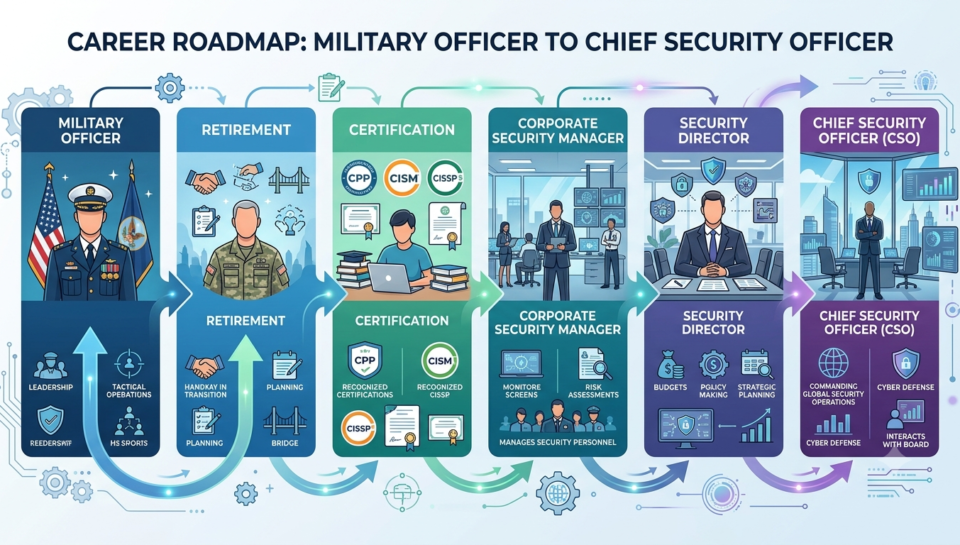
How much can you earn in corporate security? What certifications do employers value? And what is the roadmap from retiring officer to Security Director, Chief Security Officer, or Risk Executive?
In Part 3, we’ll explore salary expectations, career pathways, professional certifications, and why governance—not command—is becoming the defining competency of tomorrow’s security leaders.
PASSMI • Certified Security & Safety Management Professional
Your Experience Earns Respect. Your Leadership Education Opens Doors.
Prepare for your next mission with the Certified Security & Safety Management Professional (CSSMP). Gain executive-level competencies in governance, enterprise risk management, regulatory compliance, crisis leadership, business continuity, and strategic security management. 📅 July 20–24, 2026
🌐 Hybrid Learning Setup July 20–23 — Online Sessions July 24 — Face-to-Face in Ormoc City (Final Examination • Project Defense • Graduation)
Know someone assigned in the Visayas? Share this opportunity with your fellow military, police, fire, coast guard, corrections, safety, and security professionals in Leyte, Samar, Cebu, Negros, Bohol, Iloilo, and nearby provinces.
