Are Philippine Schools Really Prepared for the Unthinkable?

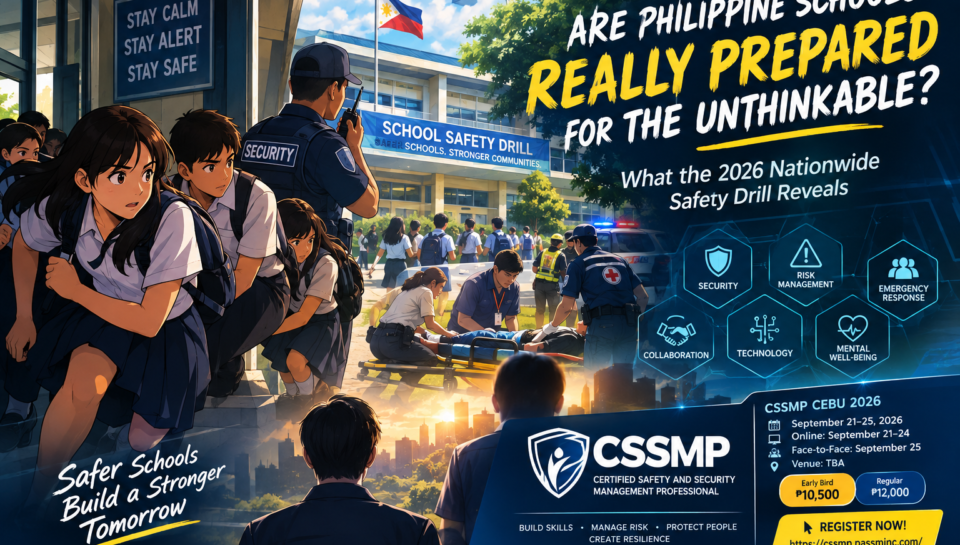
On September 3, 2026, schools across the Philippines participated in a Nationwide Simultaneous School Safety Drill designed to strengthen preparedness for emergencies and active threat situations.
The exercise brought together schools, teachers, learners, local government units, law enforcement, emergency responders, and other stakeholders. At Carlos F. Gonzales High School in San Rafael, Bulacan, the national activity demonstrated how school communities can coordinate their response to a serious emergency. Similar activities were conducted in schools across the country.
The timing of the drill is significant.
Following recent incidents of school violence, the conversation around school safety in the Philippines has expanded beyond familiar emergencies such as earthquakes, fires, floods, and other natural hazards. Schools are now being asked to consider another difficult question:
What happens when the threat comes from a human being rather than a natural disaster?
That question is uncomfortable. But effective safety and security management is not about avoiding difficult questions. It is about preparing responsibly for risks before they become crises.
And perhaps the most important lesson from the nationwide drill is this:
School safety is no longer simply about having security guards, gates, CCTV cameras, and emergency exits. It is about having people, systems, plans, and partnerships that work together when something goes wrong.
What Happened During the Nationwide School Safety Drill?
The September 3 exercise focused on strengthening the ability of schools to respond to emergencies and active threat situations while protecting the physical and psychological well-being of learners.
According to the Department of Education, the exercise emphasized localized school contingency plans, coordination among agencies, emergency response procedures, and continuity of education.
The exercise included elements such as lockdown procedures, emergency coordination, evacuation considerations, headcounts, first aid, and post-incident support.
In Quezon City, for example, the Quezon City Police District worked with DepEd, the Quezon City Disaster Risk Reduction and Management Office, teachers, parents, and barangay officials during active attack incident simulation exercises at Quirino High School and Batasan Hills National High School.
However, there is an important distinction that should not be overlooked.
DepEd deliberately avoided hyper-realistic simulations that could cause unnecessary fear or psychological distress among students. The department adopted a trauma-informed and age-appropriate approach, with advance orientation, parental consent, learner accommodations, and post-drill psychological support incorporated into the preparations.
That decision itself provides an important lesson for safety professionals:
A good emergency drill should build preparedness—not trauma.
School Safety Is More Than Physical Security
For many organizations, security is still viewed primarily through a physical lens.
Is the gate secured?
Are there enough security guards?
Are CCTV cameras working?
Are visitors properly logged?
Are emergency exits accessible?
These questions remain important. But they represent only one layer of organizational security.
Modern safety and security management requires a much broader view.
A school, for example, is a complex environment involving students, teachers, administrators, security personnel, contractors, parents, visitors, government agencies, and service providers.
A security incident affecting one part of the organization can quickly affect everyone else.
A lockdown can affect emergency medical response.
An evacuation can affect accountability and student tracking.
A violent incident can create psychological consequences long after the physical threat has ended.
A major emergency can interrupt classes, damage facilities, create reputational concerns, and disrupt the continuity of education.
This is why school security in the Philippines needs to be considered as part of a wider safety, risk, and resilience framework.
Security is not a standalone function.
It is part of organizational resilience.
Are Philippine Schools Prepared for Human-Induced Threats?
The nationwide drill is an important step, but a drill by itself does not automatically mean that an organization is prepared.
Preparedness is demonstrated when people understand what to do, who is responsible, how decisions are made, and how different agencies coordinate during an actual emergency.
That raises several questions for school administrators and safety professionals.
1. Does the school have a practical emergency response plan?
Having a written contingency plan is important.
But a plan that sits inside a filing cabinet is not necessarily a useful plan.
School personnel should understand their responsibilities and know how the plan translates into actual actions.
Who initiates the emergency response?
Who communicates with parents?
Who contacts emergency responders?
Who accounts for students?
Who manages access to the campus?
Who coordinates with police or local government?
Who provides first aid?
Who supports students and employees after the incident?
A good emergency plan answers these questions before an emergency occurs.
2. Are security personnel integrated into the emergency plan?
Security guards are often among the first people to encounter an unusual situation.
They may be positioned at entrances, gates, parking areas, or other strategic locations.
But security personnel cannot be expected to manage every emergency alone.
Their responsibilities should be clearly integrated into the organization’s overall emergency management system.
This means coordination between security, school administrators, teachers, emergency responders, and other stakeholders.
The goal should not simply be to have guards present.
The goal should be to have trained people who understand their role within a coordinated response system.
3. Do employees and teachers know what to do?
Emergency preparedness cannot be delegated entirely to the security team.
Teachers are responsible for students.
Administrators make critical decisions.
Maintenance personnel may understand building systems better than anyone else.
Security personnel may control access points.
Medical personnel may manage injuries.
Every group has a role.
This is why effective emergency preparedness requires role clarity and communication.
People do not need to become security experts.
They need to know what they are expected to do when an emergency occurs.
The Importance of Drills: Practice Without Creating Fear
There is a common misconception that the more realistic an emergency drill is, the more effective it will be.
That is not necessarily true.
DepEd’s approach to the September 3 exercise demonstrates why.
The department specifically emphasized trauma-informed implementation and prohibited fear-inducing elements such as firearms, simulated gunfire, weapons, artificial casualties, and aggressive role-playing in schools.
The objective was to build what DepEd described as calm operational confidence and preparedness rather than fear.
That is an important principle for safety professionals across industries.
A drill should answer:
Can people perform the required actions correctly under pressure?
It does not necessarily need to answer:
Can we make this feel exactly like a real attack?
There is a difference.
Effective drills should be carefully designed around the people participating in them, the risks being addressed, and the organization’s objectives.
The same principle applies to businesses, hospitals, malls, factories, offices, and other facilities.
The objective is not to scare people.
The objective is to make the correct response more familiar.
From Compliance to Safety Culture
One of the biggest lessons from the national school safety drill is the difference between compliance and preparedness.
An organization may conduct a drill because regulations require it.
It may complete the attendance sheet.
It may take photographs.
It may submit a report.
But the more important question is:
Did the organization learn anything?
After every drill, organizations should ask:
- What worked?
- What failed?
- Where did communication break down?
- Were emergency contacts updated?
- Did everyone understand their role?
- Were evacuation or lockdown procedures practical?
- Were vulnerable individuals properly considered?
- Did security personnel know what to do?
- Were emergency responders able to coordinate effectively?
- What needs to change before the next exercise?
This is where a safety drill becomes valuable.
A drill should not simply be an event.
It should be part of a continuous improvement cycle.
Plan.
Prepare.
Exercise.
Evaluate.
Improve.
Repeat.
That is how organizations develop a genuine safety culture.
The Human Element of School Security
Technology will continue to play an important role in security.
CCTV systems, access control, alarms, communication systems, visitor management platforms, emergency notification systems, and other technologies can significantly strengthen security.
But technology does not replace people.
A CCTV camera cannot make a decision by itself.
An access-control system cannot understand every unusual situation.
An emergency notification system cannot replace leadership.
And a security system cannot compensate for people who do not know what to do.
The most effective approach is therefore not people versus technology.
It is people supported by technology, systems, training, and information.
This is particularly important as security threats become more complex.
Today’s safety professional may need to understand physical security, risk assessment, emergency response, business continuity, technology, data privacy, communication, and crisis management at the same time.
That is a much broader responsibility than traditional security management.
From Emergency Response to Organizational Resilience
There is another lesson hidden inside the school safety conversation: what happens after the emergency?
Suppose an incident occurs and the immediate threat is contained.
Is the organization automatically recovered?
Not necessarily.
Classes may need to be suspended.
Parents may need information.
Students and teachers may need psychological support.
Facilities may require assessment.
Authorities may need access to records.
Communication channels may need to remain active.
Leadership may need to make decisions about returning to normal operations.
This is where business continuity and resilience become important.
Emergency management answers:
How do we respond?
Business continuity asks:
How do we continue operating?
Resilience asks a broader question:
How do we adapt, recover, learn, and become stronger after disruption?
These concepts should not be limited to large corporations.
They are relevant to schools, small businesses, hospitals, government offices, manufacturing facilities, and practically every organization responsible for people.
A Whole-of-Community Approach Is Essential
No school can manage every serious emergency alone.
The September 3 drill demonstrated the importance of collaboration among DepEd, local governments, law enforcement, emergency responders, school personnel, parents, and communities.
That is a model worth extending beyond schools.
Safety is strongest when organizations understand their external partners before an emergency happens.
Who is the nearest police unit?
Where is the nearest medical facility?
Who from the local government should be contacted?
How will emergency responders access the facility?
Who communicates with families?
What information can be released publicly?
How will misinformation be addressed?
These relationships should ideally be established and tested before a crisis.
Because during an emergency, it is too late to start asking:
“Who should we call?”
What Can Other Philippine Organizations Learn From This?
The lessons from the nationwide school safety drill apply far beyond education.
Every organization can benefit from reviewing its own emergency preparedness.
Start with five questions:
1. What are our most realistic threats?
Do not rely solely on generic emergency plans. Consider the actual risks associated with your location, people, operations, facilities, and environment.
2. Do our people know what to do?
Policies are only effective when people understand them.
3. Are our security and safety functions connected?
Physical security, occupational safety, emergency management, IT, HR, facilities, and leadership should not operate in isolation.
4. Do we practice our plans?
Training and exercises help identify weaknesses that documents cannot reveal.
5. Do we learn from every exercise?
A drill should result in improvements, not merely photographs and attendance records.
These questions can help organizations move from a reactive approach to a proactive one.
The Bigger Question: Who Is Responsible for Safety?
Perhaps the most important lesson from the September 3 school safety drill is that security cannot belong to only one person or department.
It cannot belong exclusively to the security guard.
It cannot belong exclusively to the safety officer.
It cannot belong exclusively to the school principal, HR department, facilities manager, or executive team.
Safety is a shared organizational responsibility.
But shared responsibility does not mean unclear responsibility.
Organizations still need professionals who can assess risks, develop systems, coordinate stakeholders, manage emergencies, and help leadership make informed decisions.
This is why the role of the modern safety and security professional is becoming increasingly important.
The professional of the future needs to think beyond a single incident.
They need to understand risk before the incident, response during the incident, and resilience after the incident.
Preparing the Professionals Behind Safer Organizations
The conversation surrounding school safety in the Philippines is ultimately a conversation about people.
We need safer schools.
But we also need capable professionals who understand how to build safer organizations.
This requires more than technical knowledge.
It requires an understanding of safety and security management, risk management, emergency and crisis management, corporate governance, business continuity, technology, data privacy, communication, and collaboration.
For professionals who want to develop these capabilities, the Certified Safety and Security Management Professional (CSSMP) program provides a structured learning opportunity focused on the broader responsibilities of modern safety and security leadership.
The program covers critical areas including:
- Safety & Security Management
- Risk Management
- Corporate Governance & Ethics
- Emergency & Crisis Management
- Business Continuity & Resiliency
- Collaboration & Networking
- Technology Integration
- Social Media Policy & Misinformation
- Data Privacy
These areas are increasingly interconnected.
A crisis can begin as a physical security issue and quickly become a communications problem.
A cybersecurity incident can become an operational disruption.
A workplace accident can become a reputational crisis.
A school emergency can require coordination between administrators, security personnel, emergency responders, parents, health professionals, and government agencies.
The modern professional therefore needs to understand the whole picture.
That is the thinking behind the CSSMP program.
It is not simply about adding another certificate to a résumé. It is about developing professionals who can help organizations identify risks, lead during emergencies, protect people, coordinate stakeholders, and build resilience.
CSSMP Cebu 2026
For professionals looking to strengthen their capabilities in safety and security management, the CSSMP Cebu 2026 program will be held from September 21–25, 2026.
The program will be conducted online from September 21–24, followed by a face-to-face session on September 25.
CSSMP Cebu 2026
📅 September 21–25, 2026
💻 Online: September 21–24
🤝 Face-to-Face: September 25
📍 Venue: TBA
💰 Early Bird: ₱10,500
💰 Regular: ₱12,000
Final Takeaway: Preparedness Is a Leadership Responsibility
The nationwide school safety drill should not be viewed simply as another government exercise.
It represents a broader shift in how we think about safety in the Philippines.
Schools have always prepared for earthquakes, fires, severe weather, and other emergencies. But today’s risk environment requires organizations to consider a wider range of threats while protecting the people they serve.
The answer is not fear.
The answer is not simply more security equipment.
And it is not enough to conduct a drill once a year.
The answer is preparedness.
Preparedness means understanding risks.
It means having practical plans.
It means training people.
It means coordinating with external partners.
It means using technology appropriately.
It means protecting physical and psychological well-being.
It means learning from exercises.
And, most importantly, it means building organizations that can continue to function when something unexpected happens.
The question facing Philippine schools—and indeed Philippine organizations—is therefore not simply:
“Are we safe?”
A better question is:
“If something goes wrong tomorrow, are we prepared to respond?”
Because safety is not proven when everything is normal.
Safety is proven by how well an organization is prepared when normal suddenly changes.
