The Hidden Risks of Ignoring Fire Code Compliance

In many organizations, fire safety is still viewed as a facilities issue.
The responsibility is often delegated to maintenance teams, building administrators, or safety officers tasked with ensuring that extinguishers are inspected, exits are marked, and permits are renewed before deadlines.
This narrow perspective creates a dangerous blind spot.
Modern organizations operate in increasingly complex environments where operational continuity, regulatory accountability, reputational exposure, and human safety are deeply interconnected. In this context, Fire Code compliance is no longer simply about avoiding penalties or passing inspections.
It is about organizational resilience.
For corporate leaders, security directors, compliance officers, and risk managers, the Fire Code of the Philippines should not be viewed as a checklist.
It should be understood as a governance framework designed to reduce the probability and consequences of catastrophic failure.
Organizations that fail to recognize this distinction often discover the true importance of fire compliance only after a crisis occurs.
By then, the consequences are no longer operational.
They become legal, financial, reputational, and human.
Fire Safety as a Governance Issue
The traditional approach to fire safety focuses heavily on technical compliance.
Questions often revolve around:
• Are extinguishers available?
• Are alarms functioning?
• Have inspections been completed?
• Is the Fire Safety Inspection Certificate updated?
These questions are important.
But they are incomplete.
The more strategic question is this:
Does the organization have a governance system capable of sustaining fire safety readiness over time?
This is where executive leadership becomes critical.
Fire incidents rarely become catastrophic because of a single failed component. More often, disasters emerge from layers of governance breakdowns:
• Delayed maintenance
• Poor documentation
• Weak emergency planning
• Inadequate risk assessments
• Budgetary neglect
• Compliance treated as a formality rather than a leadership responsibility
In other words, fire safety failures are often organizational failures.
Understanding the Fire Code of the Philippines
The Fire Code of the Philippines, officially Republic Act No. 9514, establishes the legal framework governing fire prevention and suppression across the country.
Implemented primarily through the Bureau of Fire Protection (BFP), the law outlines mandatory requirements for:
• Building fire safety systems
• Occupancy standards
• Emergency exits
• Fire suppression systems
• Alarm systems
• Inspection procedures
• Fire drills and emergency preparedness
Businesses are required to secure Fire Safety Inspection Certificates (FSICs) as part of operational and business permit requirements.
Local Government Units (LGUs) frequently coordinate with the BFP to ensure compliance before permits are issued or renewed.
However, the operational reality in the Philippines presents several challenges.
Many organizations approach compliance reactively.
Documentation is prepared only near inspection periods. Maintenance schedules are inconsistent. Fire drills become ceremonial exercises rather than meaningful preparedness programs.
These gaps create operational vulnerabilities that may remain invisible until an actual emergency occurs.
The Executive Risk Perspective
Security leaders and executives should evaluate fire compliance using enterprise risk management principles.
A fire incident does not merely threaten property.
It can affect:
• Human life and employee welfare
• Operational continuity
• Regulatory standing
• Insurance exposure
• Investor confidence
• Brand reputation
• Contractual obligations
• Supply chain continuity
For industries operating critical facilities such as manufacturing plants, commercial buildings, BPOs, malls, hotels, logistics hubs, and event venues the impact of fire-related disruptions can extend far beyond the affected site.
This is why leading organizations integrate fire safety into broader governance and business continuity frameworks.
Lessons from Publicly Reported Philippine Incidents
The importance of fire compliance becomes clearer when examining publicly reported incidents in the Philippines.
One of the most tragic examples remains the Ozone Disco fire in Quezon City in 1996.
The incident claimed more than 160 lives and remains one of the deadliest nightclub fires in Philippine history.
Investigations and public reports cited several alleged deficiencies, including overcrowding, insufficient emergency exits, and inadequate fire safety measures.
The tragedy demonstrated how compliance gaps, when combined with poor emergency preparedness, can produce catastrophic outcomes.
Another widely reported incident was the Kentex Manufacturing factory fire in Valenzuela City in 2015.
Dozens of workers lost their lives after a fire rapidly spread through the facility.
Public investigations raised concerns regarding workplace safety standards, emergency exits, and fire preparedness measures.
The incident intensified national discussions around regulatory enforcement, labor safety, and industrial compliance.
More recently, periodic reports of BFP enforcement operations against establishments lacking proper Fire Safety Inspection Certificates highlight ongoing compliance issues across various industries.
These incidents collectively reinforce a critical lesson:
Fire safety regulations are not arbitrary administrative requirements.
They exist because past tragedies demonstrated the devastating consequences of inadequate oversight.
Fire Code Compliance and Business Continuity
One of the most overlooked aspects of fire compliance is its direct relationship with business continuity.
Organizations often invest heavily in cybersecurity, physical security systems, and crisis management planning while underestimating the operational disruption caused by fire incidents.
A significant fire event can:
• Halt operations for weeks or months
• Disrupt supply chains
• Trigger regulatory investigations
• Result in legal claims
• Damage customer trust
• Affect employee morale
Organizations with mature business continuity programs understand that fire compliance is not separate from resilience planning.
It is a foundational component of it.
Common Compliance Gaps in Philippine Organizations
Several recurring compliance weaknesses are commonly observed across organizations.
These include:
Documentation Gaps
Inspection records, maintenance logs, and compliance reports are often incomplete or inconsistently updated.
Inadequate Risk Assessments
Some organizations conduct generic fire assessments without considering operational realities such as occupancy changes, equipment risks, or crowd density.
Weak Emergency Preparedness
Emergency drills may be conducted merely for compliance purposes rather than realistic response readiness.
Budgetary Constraints
Fire safety upgrades are sometimes delayed due to cost considerations despite known risks.
Poor Coordination Across Departments
Facilities management, security, compliance, and executive leadership may operate independently rather than through integrated governance systems.
These gaps illustrate why compliance should never be viewed as a standalone technical function.
It requires organizational coordination.
A Strategic Fire Risk Matrix
Security leaders can benefit from structured fire risk assessment models.
One useful approach involves evaluating risks based on:
Likelihood
How probable is a fire-related incident?
Impact
What would be the operational, financial, legal, and reputational consequences?
Risks can then be categorized as:
• Low
• Moderate
• High
• Critical
For example:
Critical facilities with high occupancy levels and outdated suppression systems may fall into high-risk categories requiring immediate intervention.
This approach allows executives to prioritize investments and corrective actions strategically.
Governance Structures for Fire Safety Leadership
Strong organizations integrate fire compliance into governance structures rather than assigning it solely to facilities departments.
A mature governance framework may include:
Board or Executive Oversight
Ensuring fire safety risks are included in enterprise risk discussions.
Corporate Safety Committees
Coordinating compliance, preparedness, and incident reporting.
Security and Risk Management Teams
Monitoring operational vulnerabilities and regulatory compliance.
Facilities and Engineering Teams
Maintaining systems and infrastructure.
Legal and Compliance Departments
Monitoring regulatory obligations and contractual exposure.
This integrated structure improves accountability and reduces organizational blind spots.
Executive Reporting Framework
Fire safety reporting should evolve beyond operational metrics.
Executives require strategic visibility.
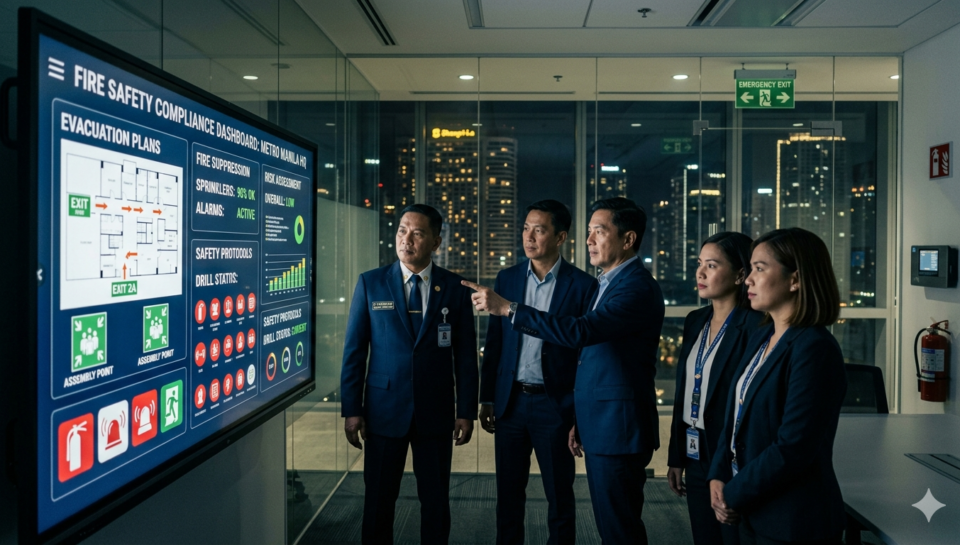
A useful executive dashboard may include:
• Fire Safety Inspection Certificate status
• Compliance deficiencies and remediation timelines
• Results of recent inspections
• High-risk facilities or operational areas
• Emergency drill performance indicators
• Incident trends and near-miss reports
• Insurance compliance concerns
This enables leadership to make informed risk-based decisions.
Fire Compliance and Corporate Liability
Under Philippine law, organizations may face substantial liability exposure following fire incidents.
Potential consequences include:
• Regulatory penalties • Suspension of operations • Civil liabilities • Insurance complications • Reputational damage
Executives should recognize that publicly reported incidents often trigger scrutiny not only of operational conditions but also of governance systems.
Investigators frequently examine:
• Inspection records
• Permit status
• Maintenance documentation
• Emergency preparedness procedures
• Executive oversight mechanisms
This is why compliance documentation and governance processes are critical.
Fire Safety in the Age of Complex Risks
Modern risk environments are becoming more complicated.
Organizations today face:
• Higher occupancy densities • Integrated smart building technologies • Increased electrical loads • Hybrid work environments • Supply chain pressures • Climate-related operational risks
As these complexities increase, fire compliance can no longer remain static.
Organizations must continuously reassess their preparedness frameworks.
Strategic Recommendations for Organizations
Organizations seeking to strengthen fire compliance should consider several strategic actions.
Integrate Fire Compliance Into Enterprise Risk Management
Fire safety should be evaluated alongside cybersecurity, operational continuity, and reputational risks.
Conduct Leadership-Level Reviews
Executives should receive regular compliance reports and risk assessments.
Improve Documentation Systems
Accurate records are essential during inspections, audits, and post-incident investigations.
Strengthen Interdepartmental Coordination
Compliance requires cooperation between facilities, security, HR, operations, and leadership.
Move Beyond Minimum Compliance
Organizations should aim for resilience, not merely inspection readiness.
The Future of Corporate Safety Leadership
The role of corporate safety leadership is evolving.
Modern organizations increasingly recognize that safety, security, governance, and operational resilience are interconnected disciplines.
Fire Code compliance therefore represents more than a legal requirement.
It is a measurable indicator of organizational maturity.
Companies that invest seriously in compliance demonstrate stronger governance cultures, better preparedness capabilities, and greater operational resilience.
Organizations that neglect compliance expose themselves to preventable risk.
Elevating Standards Through Professional Development
The growing complexity of safety and security governance requires leaders who understand regulatory compliance, enterprise risk management, emergency preparedness, and organizational resilience.
Professional organizations play an essential role in advancing these standards.
The Philippine Alliance for Safety and Security Management, Inc. (PASSMI) continues to advocate for higher professional standards through education, collaboration, and structured certification programs.
Programs such as the Certified Security & Safety Management Professional (CSSMP) certification are designed to equip executives, security directors, risk managers, and safety professionals with strategic frameworks necessary for modern leadership.
As organizations face increasingly complex operational environments, the need for compliance-driven leadership becomes more critical.
Fire safety is not simply about inspections.
It is about protecting people, sustaining operations, and building resilient organizations capable of withstanding crises.
For leaders committed to strengthening safety and security governance in the Philippines, structured professional development is no longer optional.
It is a strategic investment in organizational resilience and national safety standards.
