Geopolitical Volatility and the Philippine Enterprise: A Strategic Security Mandate

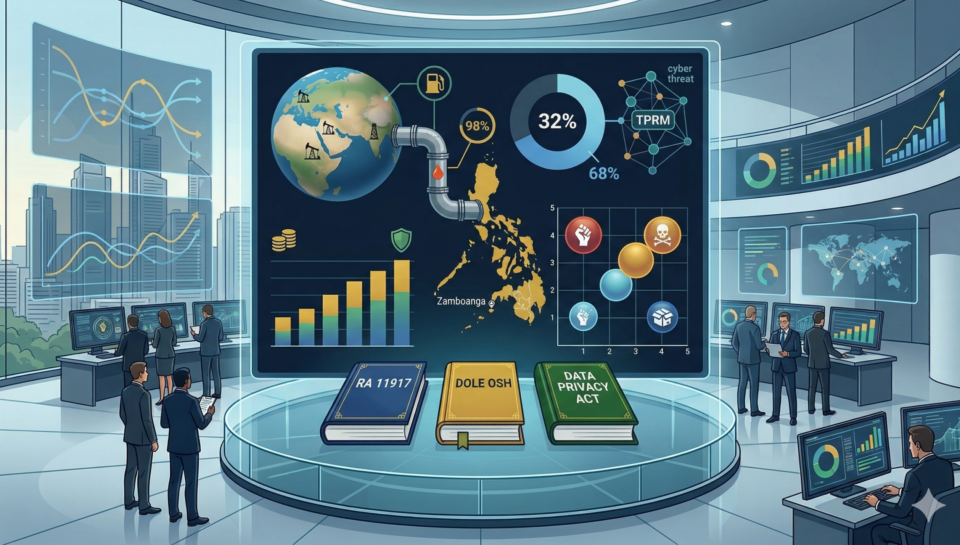
In the boardrooms, the escalating kinetic conflict in the Middle East compounded by the February 2026 strikes and subsequent retaliatory cycles is often viewed through a purely macroeconomic lens. Executives track fluctuating Brent crude prices, the Peso’s volatility against the Dollar, or the logistical nightmare of OFW repatriation. However, for the modern Security Director and Chief Risk Officer, this “distant” war represents a proximal, multi-vector threat to domestic Philippine operations.
Geopolitical instability today does not stay localized. In an era of hybrid warfare, a missile strike in the Levant manifests in Manila as heightened cyber-adversarial activity, radicalization risks in vulnerable sectors, and the potential for targeted “spillover” incidents against multinational interests. For the Philippine Alliance for Safety and Security Management (PASSMI), the mandate is clear: Philippine enterprises must transition from reactive monitoring to a “State of Readiness” that aligns with international standards and local regulatory rigors. We must move beyond the guard at the gate and address the strategy in the C-suite.
Problem Analysis: The Triple-Threat Architecture
The impact of the Middle East conflict on Philippine safety and security is a cascading failure across three critical domains:
1. The Kinetic Spillover & Internal Security
While the Philippine National Police (PNP) and the Armed Forces of the Philippines (AFP) have recently maintained there is “no direct credible threat” to the territory (March 2026), history dictates that global religious or political flashpoints serve as catalysts for local extremist elements. The risk is not a foreign invasion; it is the “inspired” domestic actor.
In the Philippines, diplomatic missions, U.S.-linked BPO hubs, and Israeli-affiliated commercial interests become symbolic targets for “lone-wolf” disruptions or civil unrest. Security governance must account for the reality that international grievances can be localized within hours via social media, leading to sudden protest surges or “soft target” vulnerabilities.
2. The Cyber-Geopolitical Nexus: The Digital “Blast Radius”
Modern warfare is inherently hybrid. As Middle Eastern state actors and hacktivist collectives (such as those observed in the 2024 and 2026 cycles) deploy destructive malware and DDoS attacks, the digital “blast radius” is global. Philippine financial institutions and critical infrastructure often reliant on shared global software supply chains are at heightened risk for collateral damage.
Furthermore, “hacktivism” in the Philippines often spikes during global conflicts. State-sponsored threat actors may use the Middle East conflict as a “smokescreen” to conduct espionage or disrupt Philippine-Western corporate partnerships, exploiting the distraction of local security teams.
3. Operational and Supply Chain Fragility: The Security of Supply
The Philippines remains acutely sensitive to Middle Eastern stability, importing nearly 98% of its crude oil from the region. Any disruption in the Strait of Hormuz handling a fifth of global oil shipments creates immediate “Security of Supply” risks.
This is fundamentally a safety issue. When fuel costs spike, the operational overhead of private security agencies (PSAs) balloon. In the Philippine “low-margin” security contracting environment, this pressure often leads to “corner-cutting” in mandatory training, equipment maintenance, and personnel vetting. A security agency struggling with fuel surcharges is an agency that may fail to deploy its Quick Reaction Force (QRF) when an actual crisis hits your facility.
Strategic Intelligence at the PASSMI National Convention 2026 – To address these cascading impacts, the upcoming PASSMI National Convention in Davao City on April 18, 2026, will feature a dedicated session: “Middle East Crisis Impact to Supply Chain Security in the Philippines and the Region.” Lead by Mr. Julius Badillo, Head of Supply Chain Security at 2GO Group, Inc. and President of the Supply Chain Security Management Society of the Philippines, this session will provide a strategic roadmap for securing the Philippine value chain. Mr. Badillo will analyze the maritime security threats in ASEAN, soaring logistics costs, and the “Triple Bottom Line” approach balancing Profit (diversified routes), People (protecting seafarers in conflict zones), and Planet (transitioning to localized, sustainable resources). For executives, this is a critical opportunity to move from vulnerability to resilience.
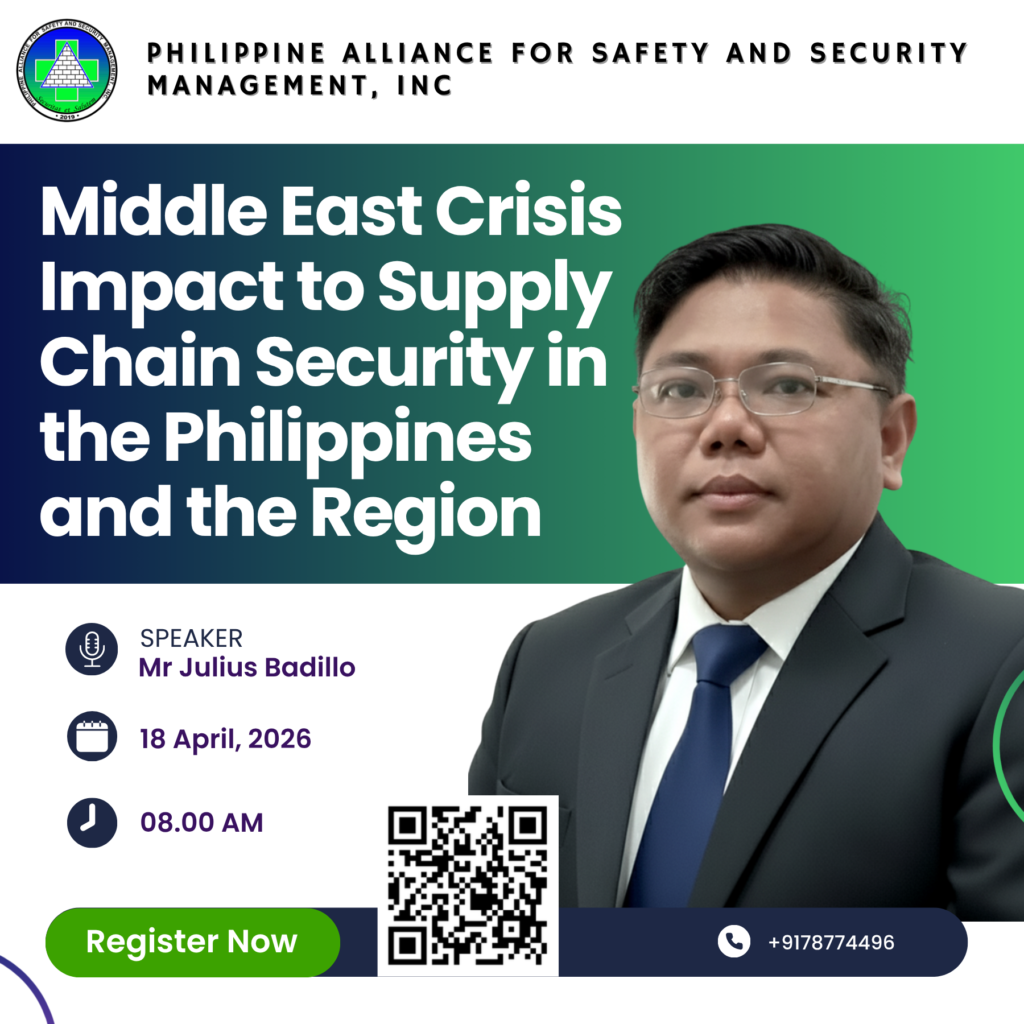
Want to attend the convention? Register here.
Philippine Context and Regulatory Implications
In the Philippine operational environment, security is a governed necessity, not a corporate preference. The current conflict necessitates a re-evaluation of compliance through several high-stakes lenses:
PNP-SOSIA and Private Security Governance (RA 11917)
Under the Republic Act No. 11917 (The Private Security Services Industry Act), the PNP-SOSIA mandates strict licensing. During geopolitical shifts, SOSIA often issues “Vigilance Directives.”
- The Compliance Gap: Many Philippine firms suffer from “paper compliance.” They possess valid licenses but lack the tactical depth required for high-threat scenarios (e.g., active shooter response or complex civil disturbance).
- Contractual Liability: Under Philippine Corporate Law, “Force Majeure” is frequently cited to absolve liability. However, a geopolitical conflict that has been escalating for months is no longer “unforeseeable.” Executives who fail to augment security during known periods of global tension may face claims of gross negligence under the principle of pater familias (diligence of a good father of a family).
Occupational Safety and Health (DOLE DO 198-18)
The Department of Labor and Employment (DOLE) standards require a workplace free from “serious actual or potential hazards.” If an enterprise is located near a high-risk diplomatic mission or a targeted multinational office, the “hazard” now includes potential civil unrest.
- Fire Code Integration (RA 9514): In the event of a “spillover” incident (e.g., an explosive device or arson), the Fire Code’s requirements for Fire Safety Practitioners become critical. Does your Fire Safety Team know how to coordinate with a tactical security team during an intentional fire incident versus an accidental one?
Data Privacy Act (DPA) of 2012 and the NPC
With geopolitically motivated hacktivism on the rise, the National Privacy Commission (NPC) requires “organizational, physical, and technical” measures.
- The Reality: A data breach caused by an Iranian or Israeli-linked hacktivist group is still a breach. Under the DPA, the “Personal Information Controller” (the company) is liable for the failure of its “Personal Information Processor” (the vendor). If your vendor’s cybersecurity is compromised due to geopolitical targeting, your organization faces the NPC fines and reputational ruin.
Publicly Reported Case Analysis: Lessons in Resilience
To understand the stakes, we must analyze how geopolitical sentiment and operational failures have intersected in the Philippines.
Case 1: The Zamboanga Siege (Contextual Proxy for Ideological Surge)
The 2013 Zamboanga Siege remains a permanent case study for Philippine risk managers. It demonstrated how ideological fervor, often fueled by global narratives, can paralyze a regional economic hub.
- The Failure: A failure of Intelligence Governance. Organizations lacked the framework to trigger Business Continuity Plans (BCP) based on “pre-kinetic” indicators.
- Lesson for Today: In the context of the Middle East, a “spillover” in a Manila business district requires a trigger-based evacuation protocol. If your trigger is “bullets flying,” you have already failed. The trigger must be “geopolitical escalation level X.”
Case 2: The 2024-2026 Cyber-Attacks on Government and Military Portals
As reported in early 2026, Philippine government systems faced repeated infiltration attempts. While some were linked to regional territorial disputes, the “Exodus Security” and “Medusa” incidents highlighted a critical vulnerability: Third-Party Risk Management (TPRM).
- The Failure: Almost 32% of Philippine organizations (per 2025 BlueVoyant data) have no way to detect security incidents within their supply chains.
- Lesson for Today: If your cloud provider or security software vendor has operational ties to a conflict zone, your data is part of their threat landscape. Compliance with the DPA requires a deep audit of this “digital supply chain.”
Strategic Recommendations: The PASSMI Framework for Readiness
PASSMI recommends that Security Directors adopt an “Antifragility Framework” designing systems that do not merely survive volatility but improve because of it.
1. Geopolitical Risk Integration (The 5×5 Matrix)
Geopolitical forecasting must move from the “General Interest” category to the “Active Risk” register.
- Framework: Map “Conflict Intensity” against “Local Operational Impact.”
- Tier 1 (High Probability/High Impact): Energy-driven Opex increases leading to labor strikes at your facility.
- Tier 2 (Low Probability/High Impact): Targeted cyber-sabotage of BPO infrastructure by hacktivist groups.
2. Enhanced “Security of Supply” Protocols
Review your Service Level Agreements (SLAs) with PSAs immediately.
- Requirement: Ensure your PSA has a “Continuous Operations Plan” that accounts for fuel rationing. Do they have localized “Quick Reaction Forces” (QRF) that can deploy on foot or via alternative transport if primary routes are blocked by unrest or fuel shortages?
3. Intelligence-Led Executive Reporting
Stop reporting on “Number of Guards on Post.” Start reporting on “Threat Landscape Maturity.”
- Executive Reporting Format:
- External Environment: Status of the Strait of Hormuz / Impact on local fuel and Opex.
- Sentiment Monitoring: Social listening for local “spillover” narratives or protest organizing near your sites.
- Compliance Health: Status of PNP-SOSIA clearances and DOLE OSH certifications for the current threat level.
4. The CSSMP Pathway: From Guarding to Governance
The Philippine security industry is maturing. The transition from “Guard Management” (tactical) to “Risk Governance” (strategic) requires a specialized skillset. PASSMI advocates for the Certified Strategic Security Management Professional (CSSMP) designation. This is not a “security guard” certificate; it is a professional pathway for executives to master the intersection of law, technology, and geopolitical risk.
Governance Structure: The Crisis Management Team (CMT)
Executives should implement a tiered governance structure to handle geopolitical spillovers:
- The Board: Sets the “Risk Appetite” (e.g., “We will cease operations if fuel prices hit X or if a Level 2 PNP Alert is issued”).
- The CMT: Composed of Legal, HR, Security, and IT. They interpret global events into local actions (e.g., “Conflict in Yemen = Increase Cyber-Monitoring of our Logistics Vendor”).
- Site Security: Executes the tactical shift (e.g., “Switch to Shelter-in-Place mode”).
The Professional Mandate
The Middle East conflict is a stark reminder that the Philippine enterprise is part of a global, interconnected, and often volatile ecosystem. We cannot control the geopolitics of the Gulf, but we can control our Organizational Resilience.
Security is no longer a cost center; it is a strategic enabler of business continuity. It is the assurance that our protocols under the Fire Code, the Data Privacy Act, and PNP regulations are not just checkboxes, but active components of a defensive posture that protects our people, our data, and our reputation.
This is not guard-level training.
This is executive-level elevation.
Leaders define industries.
