The Hidden Cost of Poor Risk Assessment

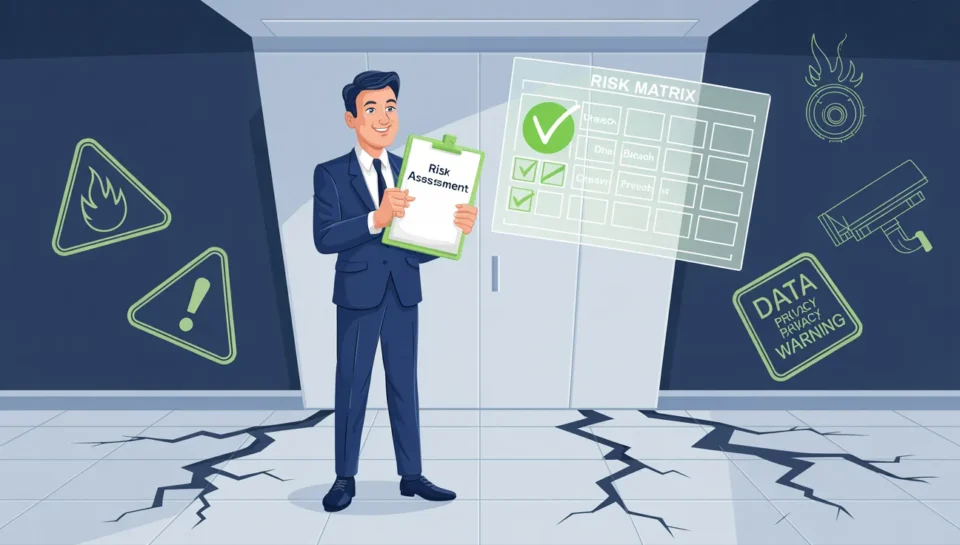
Most organizations believe they have conducted a risk assessment.
There is a document.
There is a checklist.
There is a signature at the bottom.
But here is the uncomfortable truth:
A completed form is not the same as a completed analysis.
And in the Philippine operating environment where regulatory compliance, public scrutiny, and corporate liability intersect poor risk assessment is not a paperwork problem.
It is a governance problem.
And governance failures are expensive.
What “Poor” Risk Assessment Actually Looks Like
Poor risk assessment is rarely dramatic.
It looks like:
-
Copy-paste templates reused across sites
-
No site-specific threat modeling
-
No updated likelihood scoring
-
No documentation of residual risk
-
No executive review
-
No integration with regulatory obligations
In many cases, risk assessments are conducted to comply with inspection requirements not to guide decisions.
This is especially common in environments where compliance culture is inspection-driven rather than governance-driven.
In the Philippines, organizations often prepare documentation for:
-
Bureau of Fire Protection inspections
-
LGU permit renewals
-
DOLE occupational safety compliance
-
PNP-SOSIA audits (for agencies)
But the purpose of risk assessment is not to satisfy regulators.
It is to inform leadership.
The Financial Cost
When risk is misidentified or underestimated, the financial impact compounds across multiple layers.
-
Operational disruption
-
Asset damage
-
Insurance premium increases
-
Litigation exposure
-
Contractual penalties
-
Brand damage
Consider publicly reported industrial fires and large-scale incidents in the Philippines. Post-incident investigations revealed systemic safety oversight gaps and failure to anticipate risk conditions.
The financial consequences extended beyond immediate damage:
-
Legal proceedings
-
Corporate penalties
-
Reputational damage
-
Long-term regulatory scrutiny
The root problem was not absence of manpower.
It was failure in risk evaluation and escalation.
Risk assessment, when treated as a compliance checkbox, becomes a liability multiplier.
The Legal and Regulatory Cost
Under Philippine regulatory frameworks, multiple laws intersect with security and safety functions:
-
Fire Code of the Philippines (RA 9514)
-
Data Privacy Act of 2012 (RA 10173)
-
Occupational Safety and Health Law (RA 11058)
-
PNP-SOSIA regulations for private security agencies
-
LGU occupancy and business permit requirements
A weak risk assessment often fails to integrate these obligations.
For example:
If CCTV systems are deployed without evaluating data retention risk and access controls, the organization may violate Data Privacy Act principles.
If occupancy risk is not reassessed after layout changes, Fire Code exposure increases.
If vendor compliance is not included in risk mapping, PNP-SOSIA violations may cascade into client liability.
A manager checks whether documents exist.
A leader verifies whether risk exposure has been evaluated realistically.
The Reputational Cost
Reputation in the Philippines spreads faster than fire.
One incident, amplified through social media, can reshape public trust overnight.
When publicly reported incidents occur whether crowd surges, fire safety failures, or security lapses public discussion often turns to one question:
“Was this preventable?”
If risk assessment documentation reveals obvious, unaddressed vulnerabilities, the narrative shifts from accident to negligence.
Reputation damage often exceeds physical damage.
The Psychological Cost Inside Organizations
Poor risk assessment creates internal blindness.
Executives assume exposure is controlled.
Security managers assume documentation is sufficient.
Compliance officers assume inspection equals safety.
This illusion is dangerous.
Because risk does not care about assumptions.
When leadership does not receive structured risk reporting including likelihood, impact, residual risk, and escalation status decision-making becomes reactive.
Security becomes firefighting.
Instead of prevention.
What Proper Risk Assessment Should Include
An effective risk assessment framework in the Philippine context should include:
1. Site-Specific Threat Identification
Not generic threats.
Actual localized exposure.
For example:
-
Proximity to high-density areas
-
History of protest activity
-
Flood or typhoon vulnerability
-
Electrical load stress conditions
-
Crowd concentration patterns
Risk must reflect reality.
2. Likelihood vs. Impact Matrix
Every identified risk should be scored based on:
-
Probability of occurrence
-
Operational impact
-
Financial impact
-
Legal exposure
-
Reputational impact
Residual risk must be documented after controls are applied.
Without residual scoring, leadership cannot prioritize mitigation investments.
3. Regulatory Cross-Mapping
Each risk must be evaluated against:
-
Fire Code compliance
-
Data Privacy exposure
-
OSH requirements
-
PNP-SOSIA obligations (if applicable)
-
LGU permit alignment
This integration ensures compliance is embedded in risk thinking.
4. Executive Escalation Framework
Risk assessment findings must not stay within operations.
They should feed into:
-
Risk Oversight Committee review
-
Executive dashboards
-
Budget allocation decisions
-
Crisis simulation planning
Risk assessment is a leadership document.
Not a filing requirement.
Publicly Reported Lessons
In several publicly documented Philippine incidents involving fire, crowd control, or regulatory non-compliance, post-event analysis revealed patterns:
-
Warnings were identified but not escalated
-
Risk scoring was outdated
-
Site changes were not reassessed
-
Compliance documentation existed but was not operationalized
The cost of poor risk assessment is rarely the first mistake.
It is the accumulation of ignored signals.
The Vendor Risk Dimension
Organizations that outsource security often fail to include vendor risk in their assessments.
Questions rarely asked:
-
Is the agency fully compliant with PNP-SOSIA licensing requirements?
-
Are firearms accountability logs audited?
-
Are training certifications verified?
-
Is contract language aligned with liability protection?
When vendors fail compliance and incidents occur, client organizations cannot claim ignorance.
Vendor risk is enterprise risk.
And enterprise risk must be assessed.
Why This Matters Now
The Philippine safety and security landscape is evolving.
Regulatory bodies are more visible.
Public accountability is stronger.
Litigation risk is increasing.
Digital evidence spreads instantly.
Poor risk assessment no longer results in quiet correction.
It results in public consequence.
Organizations that treat risk assessment as a living governance process build resilience.
Those that treat it as documentation accumulate exposure.
Elevating Risk Intelligence
Risk assessment is not about predicting catastrophe.
It is about reducing uncertainty.
It is about making invisible exposure visible.
It is about equipping leadership with clarity.
Professionalizing risk thinking requires:
-
Structured frameworks
-
Regulatory integration knowledge
-
Governance awareness
-
Executive communication skill
Experience alone does not guarantee accurate risk modeling.
Structured development strengthens it.
PASSMI advocates for elevating risk assessment from operational paperwork to strategic governance.
Through the Certified Security & Safety Management Professional (CSSMP) program, professionals are trained to:
-
Build risk matrices aligned with Philippine regulations
-
Integrate Fire Code, Data Privacy, and OSH considerations
-
Evaluate vendor compliance exposure
-
Present risk findings to executive leadership
-
Design preventive governance systems
Poor risk assessment is expensive.
Strategic risk leadership is protective.
If you are ready to strengthen how your organization evaluates exposure and makes security decisions, consider advancing through CSSMP.
Because in the end, the cost of prevention is predictable.
The cost of negligence is not.
Elevate Your Security Leadership.
If this article challenged the way you think about safety and security, the next step is structured professional development.
The Certified Security & Safety Management Professional (CSSMP) program is designed for executives, managers, and agency leaders who want to move beyond operational supervision and into risk governance, compliance integration, and strategic leadership.
This is not guard-level training.
This is executive-level elevation.
Leaders define industries.
