The Difference Between a Security Manager and a Security Leader

There is a quiet but consequential divide inside many organizations.
Two professionals may hold the same title. Both may have years of experience. Both may understand deployment schedules, incident reports, and compliance checklists.
Yet when crisis strikes, one manages activity.
The other manages risk.
That difference is not rank. It is not tenure. It is not the number of guards deployed.
It is thinking.
Security management maintains operations.
Security leadership shapes outcomes.
And if we are honest about the operating environment where regulatory enforcement is tightening, public scrutiny is immediate, and liability exposure is real organizations can no longer afford management without leadership.
If you have not yet read our foundational discussion on Why Security Is a Business Risk Function, Not a Manpower Service, this article builds directly on that principle.
Because once security is recognized as a risk function, the question becomes inevitable:
Who is capable of leading that function?
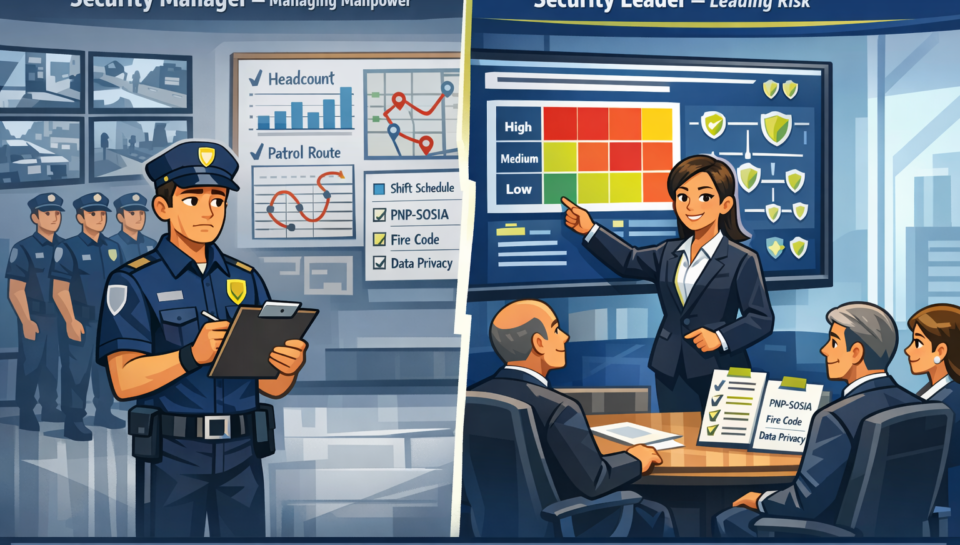
The Security Manager: Operationally Focused
A Security Manager is typically responsible for:
-
Guard deployment and scheduling
-
Incident reporting
-
Vendor coordination
-
CCTV monitoring oversight
-
Access control implementation
-
Compliance documentation preparation
These are necessary responsibilities. They keep the system running.
But they are primarily operational.
The Security Manager asks:
-
Are posts covered?
-
Are reports submitted?
-
Are permits renewed?
-
Did the guards follow procedure?
These are management questions.
And management, by itself, is not enough.
In many organizations particularly malls, manufacturing plants, business process outsourcing sites, and event venues security roles evolved from supervisory control of manpower. The historical model was simple: more guards meant more security.
But operational coverage does not equal risk control.
The Security Leader: Strategically Accountable
A Security Leader operates differently.
The Security Leader asks:
-
What are our top five enterprise security risks?
-
What is our exposure if compliance fails?
-
Are we audit-ready under PNP-SOSIA regulations?
-
How does the Fire Code intersect with our occupancy risk?
-
Is our CCTV system compliant with the Data Privacy Act?
-
What is our crisis escalation structure?
Notice the shift.
The leader is not asking about posts.
The leader is asking about exposure.
This distinction matters in the regulatory landscape.
Under PNP–SOSIA oversight, private security agencies must maintain strict licensing, firearms accountability, and training documentation. If an agency fails compliance and a client organization did not conduct proper due diligence, the liability risk escalates.
A manager may check if the guards arrived.
A leader verifies whether the agency’s License to Operate is valid and documented.
That difference protects the organization.
Decision-Making Under Pressure
The real separation appears during crisis.
Consider publicly reported incidents where investigation revealed not just operational gaps but governance gaps.
After the 2017 Resorts World Manila attack, scrutiny focused on emergency response coordination, evacuation procedures, and crisis communication. It was not enough that guards were present. The question became: was leadership prepared?
Similarly, in cases like the 2015 Kentex fire tragedy, systemic safety failures were exposed. Risk oversight was insufficient. Documentation and enforcement were inadequate.
In both situations, the issue was not guard attendance.
It was leadership failure in risk anticipation and escalation.
A Security Manager reacts.
A Security Leader prepares, anticipates, and escalates.
The Compliance Mindset vs. the Governance Mindset
Many organizations in the Philippines operate under what could be called “inspection compliance.”
As long as the Bureau of Fire Protection signs off.
As long as the LGU permit is renewed.
As long as documentation is filed.
The box is checked.
But inspection compliance is periodic.
Risk is continuous.
A Security Manager ensures requirements are submitted.
A Security Leader ensures that compliance is structurally embedded into governance.
For example:
Under the Data Privacy Act of 2012, CCTV footage is considered personal data. The National Privacy Commission has issued guidance on data handling and retention. Many organizations deploy surveillance systems but fail to align with privacy compliance documentation.
A manager ensures the cameras are functioning.
A leader ensures retention policies, access logs, and data protection protocols are defensible under audit.
That distinction prevents reputational crisis.
Risk Thinking vs. Activity Thinking
The Security Manager measures activity:
-
Number of patrols
-
Incident response time
-
Guard headcount
-
Shift completion rates
The Security Leader measures exposure:
-
Likelihood vs. impact of threats
-
Residual risk after controls
-
Vendor compliance integrity
-
Litigation exposure probability
-
Crisis readiness score
One tracks motion.
The other tracks vulnerability.
In enterprise risk discussions, boards do not want activity metrics. They want exposure metrics.
If security cannot translate its function into business risk language, it remains marginalized as manpower support.
Governance Structure: Where the Difference Becomes Visible
In mature organizations, security leadership is integrated into enterprise risk governance.
A simplified model:
Board of Directors
↓
Risk Oversight Committee
↓
Chief Risk / Security Officer
↓
Operational Security Management
If security reports only within facilities or administration, it remains operational.
If security reports within enterprise risk governance, it becomes strategic.
The Security Leader seeks board visibility.
The Security Manager seeks operational stability.
Both are important. Only one shapes institutional resilience.
Vendor Management: A Philippine Reality Check
Public advisories from PNP-SOSIA periodically highlight non-compliant agencies, expired licenses, and firearms documentation violations.
When organizations outsource security without due diligence, they expose themselves to:
-
Contractual disputes
-
Reputational damage
-
Regulatory investigation
-
Operational disruption
A manager confirms the contract exists.
A leader audits the agency’s regulatory standing.
A manager renews agreements.
A leader inserts compliance warranties and audit rights into contracts.
Security leadership protects the organization before exposure occurs.
The Psychological Shift
The difference is not technical skill.
It is psychological posture.
Managers focus on control.
Leaders focus on accountability.
Managers maintain order.
Leaders define standards.
Managers think in shifts.
Leaders think in scenarios.
The Philippines is experiencing increasing professionalization of safety and security practice. Regulatory bodies are more visible. Corporate governance expectations are rising. Public scrutiny is amplified by social media exposure.
The era of manpower-only security is fading.
The era of accountable leadership is emerging.
Practical Comparison Framework
Here is a simplified diagnostic for organizations:
If your security function:
-
Reports only on incidents
-
Focuses primarily on deployment
-
Engages executives only after crises
-
Treats compliance as paperwork
-
Relies on vendor assurances without verification
You have security management.
If your security function:
-
Conducts risk modeling
-
Escalates vulnerabilities to executive committees
-
Audits vendor compliance proactively
-
Integrates Fire Code, Data Privacy, and OSH requirements
-
Maintains crisis simulation protocols
You have security leadership.
The difference determines whether incidents become contained events or institutional failures.
Why This Matters Now
In today’s environment, organizations face layered exposure:
-
Physical threats
-
Regulatory compliance risk
-
Data privacy violations
-
Fire safety liabilities
-
Occupational safety obligations
-
Reputational amplification
Security intersects with all of them.
Without leadership-level thinking, security remains reactive.
With leadership-level thinking, security becomes preventive.
The question is not whether your organization has guards.
The question is whether your organization has governance.
Elevating the Standard
The Philippine safety and security industry is evolving.
Professionalization requires structured education in:
-
Enterprise risk thinking
-
Regulatory integration
-
Compliance documentation
-
Executive reporting
-
Crisis governance
-
Vendor oversight
Experience alone does not create leadership.
Structured development does.
PASSMI advocates for elevating the role of security from operational supervision to strategic risk governance.
Through programs such as the Certified Security & Safety Management Professional (CSSMP), professionals are equipped to transition from managing posts to leading protection frameworks.
Security leadership is not about authority.
It is about responsibility.
If you are ready to move beyond managing manpower and into shaping institutional resilience, it is time to invest in leadership-level capability.
Because the difference between a Security Manager and a Security Leader is not the title.
It is the thinking.
And thinking defines outcomes.
To learn more about how CSSMP develops executive-level security leadership, connect with PASSMI and take the next step toward professional elevation.
Elevate Your Security Leadership.
If this article challenged the way you think about safety and security, the next step is structured professional development.
The Certified Security & Safety Management Professional (CSSMP) program is designed for executives, managers, and agency leaders who want to move beyond operational supervision and into risk governance, compliance integration, and strategic leadership.
This is not guard-level training.
This is executive-level elevation.
Leaders define industries.
